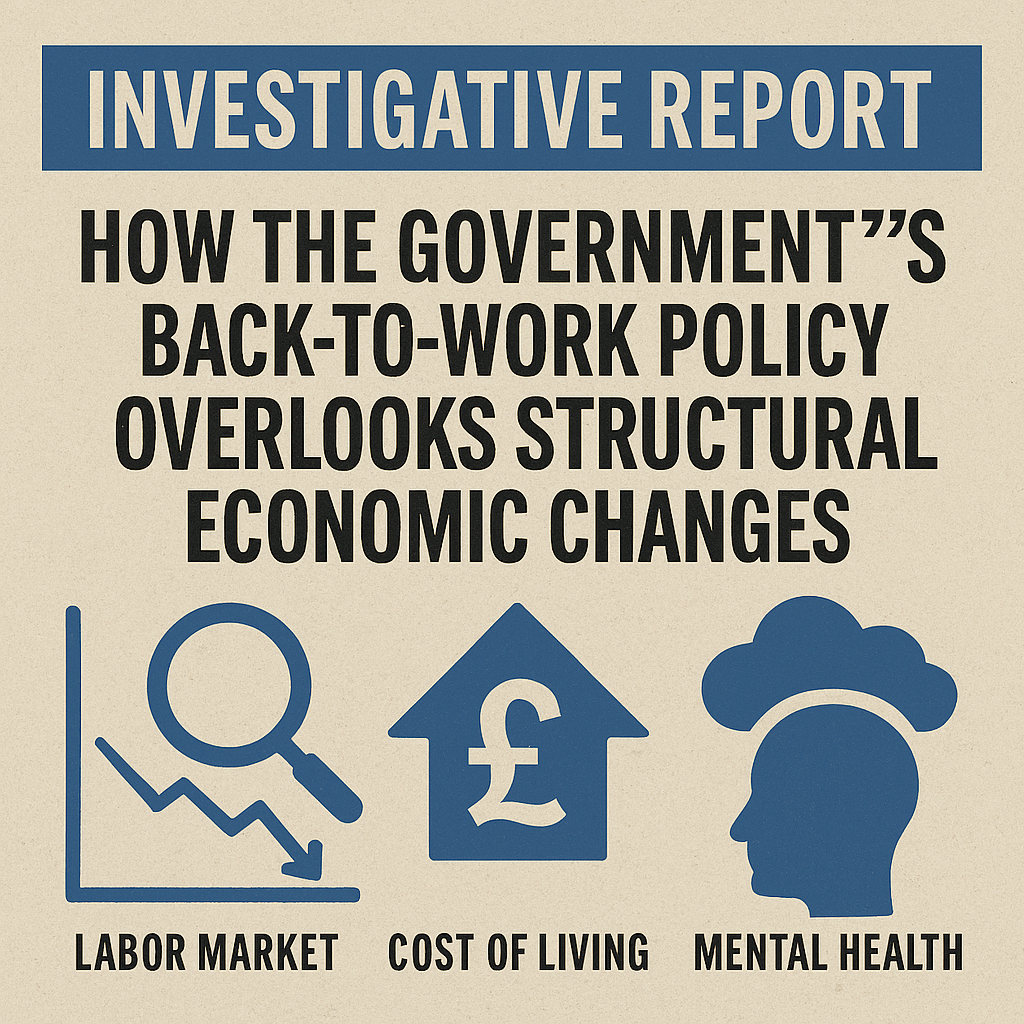
The government's flagship Keep Britain Working review claims to tackle the UK's economic inactivity crisis. But a closer examination reveals a report designed around political timelines, not economic reality. It focuses on short term health and employer behaviour while ignoring the deeper structural forces, deindustrialisation, weak labour demand, regional decline that created today's crisis in the first place.
This investigation shows how the report's narrow scope allows ministers to claim action without addressing the root causes of worklessness. The result is a back to work plan that never asks what happened to the work.
🎯 Investigation Findings
- Narrow remit by design: Review commissioned only to examine employer behaviour, not wider economic landscape
- Health focus masks structural issues: Treats symptoms of economic decline as if they were causes
- 729,000 total vacancies: Evidence of hollowed out labour market, not job abundance
- Deindustrialisation ignored: No mention of 40 year collapse in manufacturing employment
- Political timeline prioritised: Quick wins favoured over long term structural reform
📋 The Review That Promises a Lot But Only Looks in One Direction
The Keep Britain Working review was published as the government's answer to rising economic inactivity. Its headline claim is clear: ill health is now one of the biggest drivers keeping people out of work.
The Review's Focus Areas
The report identifies four primary issues:
- Mental ill health among young people - rising anxiety and depression affecting workplace participation
- Older workers leaving due to chronic conditions - early retirement driven by health concerns
- Inconsistent employer support - workplace policies failing to accommodate health needs
- Fear based workplace cultures - environments discouraging disclosure of health issues
The Proposed Solutions
It frames the crisis as a health and behaviour problem, solvable through:
🛠️ Keep Britain Working Solutions
- Better employer practices: Enhanced workplace health policies and accommodations
- Improved workplace culture: Reducing stigma around mental and physical health conditions
- Faster access to occupational health: Streamlined pathways to workplace support services
- Tweaks to sick notes: Modified return to work pathways and conditionality
- Enhanced employer engagement: Incentives for businesses to support health related employment
But this framing is only possible because the review's remit was deliberately narrow. It was commissioned to examine employers' role in tackling health based inactivity, not the wider economic landscape that shapes employment opportunities.
🏭 What the Review Leaves Out: The Collapse of the UK's Job Base
The UK's labour market problems did not begin with a spike in ill health. They began with deindustrialisation.
The Scale of Industrial Decline
From the 1980s onward, the UK lost millions of stable, well paid industrial jobs. Entire regions, South Wales, the North East, the Midlands, parts of Scotland saw their economic foundations collapse:
The result was:
- Fewer jobs overall - manufacturing decline not offset by service sector growth
- Fewer secure jobs - shift from permanent to temporary and gig economy work
- Fewer skilled jobs with progression - loss of apprenticeship pathways and career development
- Long term regional labour market scarring - communities still recovering decades later
Today, the ONS reports around 729,000 vacancies across the entire UK economy. That is not a sign of abundance. It is evidence of a hollowed out labour market where millions of people compete for a narrow band of low paid, insecure service sector roles.
Yet the Keep Britain Working review does not mention deindustrialisation once.
❌ What the Review Doesn't Ask
- Does the UK have enough good jobs?
- Why did manufacturing employment collapse?
- What happened to career progression pathways?
- How has deindustrialisation affected regional health outcomes?
- Why are service sector wages insufficient for stable living?
✅ What the Review Only Asks
- How can employers better support ill workers?
- What workplace adjustments reduce health based exits?
- How can sick note systems be improved?
- What reduces workplace mental health stigma?
- How can return to work pathways be streamlined?
🩺 Ill Health as Symptom, Not Cause
The review treats mental and physical ill health as if they exist in a vacuum. But the evidence shows a different picture: economic structure shapes health outcomes.
The Health Economy Connection
People living in deindustrialised regions face a cascade of interconnected challenges:
🔗 The Economic Stress Cycle
- Higher rates of chronic illness - linked to economic insecurity and environmental factors
- Higher rates of depression and anxiety - unemployment and underemployment affecting mental wellbeing
- Higher rates of long term unemployment - skills mismatch and lack of opportunities
- Lower access to stable work - fewer employers and increased competition for available positions
- Higher exposure to poverty and insecurity - inadequate wages and benefits in available work
The Competition Reality
When millions of people chase too few jobs, the result is predictable:
- Repeated rejection - multiple applications yielding few responses
- Unstable hours - reduced hour contracts and unpredictable scheduling
- Low pay - wages insufficient for secure living standards
- Chronic stress - financial insecurity affecting physical and mental health
- Deteriorating mental health - cycle of rejection and insecurity taking psychological toll
- Increased reliance on benefits - work not providing pathway out of poverty
The review describes the symptoms but avoids the cause.
💰 The Cost of Living Crisis Is Part of the Same Story
Deindustrialisation didn't just remove jobs. It removed domestic production capacity, creating vulnerabilities that fuel today's cost of living pressures.
The Import Dependency Trap
When the UK shifted from manufacturing to imports:
- Supply chains lengthened - increased exposure to global disruptions
- Exposure to global price shocks increased - less domestic buffering capacity
- Wages stagnated - service sector unable to match manufacturing pay levels
- Productivity flatlined - shift to lower productivity service work
The Inflation Feedback Loop
Without domestic production capacity, the UK faces a repeating cycle:
🔄 The Price Wage Spiral
- 1. Prices rise - global shocks hit import dependent economy
- 2. Wages rise to catch up - minimum wage increases to maintain living standards
- 3. Businesses raise prices again - passing wage costs to consumers
- 4. The cost of living crisis repeats - no domestic production to break the cycle
- 5. Work becomes less attractive - wages insufficient for rising costs despite employment
The review cannot address this cycle because its remit excludes industrial strategy, supply chains, and productivity. It treats rising living costs as an external factor rather than a consequence of the same structural changes that hollowed out the job market.
🗳️ Why the Review Is Designed This Way: The Politics of Quick Wins
This is the part the public rarely sees. The narrow focus isn't accidental, it reflects how political pressures shape policy development.
Political Timelines vs Economic Reality
Governments operate on one year political cycles, not ten year economic cycles. If a policy doesn't show visible movement within a year, the narrative becomes: "Nothing is working. Call a general election."
Political Preferences vs Economic Needs
| Government Prefers | Economy Needs |
|---|---|
| Quick improvements in employment statistics | Long term job creation and industrial capacity |
| Visible "back to work" announcements | Sustainable career pathways and skill development |
| Short term tax receipts from increased participation | Higher productivity and wages from quality employment |
| Employer led schemes launched quickly | Comprehensive industrial strategy and regional investment |
| Tweaks to benefits and conditionality | Rebuilding domestic production and manufacturing base |
Policy Development Incentives
The political system rewards policies that deliver:
- Measurable short-term outcomes - statistics that show quarterly improvement
- Media friendly announcements - initiatives that generate positive headlines
- Employer cooperation - business community support for government initiatives
- Immediate cost savings - reduced benefit expenditure within electoral cycles
What the system discourages:
- Rebuilding industrial capacity - 10-20 year timescales with uncertain electoral returns
- Long term regional investment - benefits accrue beyond current parliamentary terms
- Reshaping economic structure - complex interventions with delayed visible results
- Confronting deindustrialisation consequences - admitting previous policy failures
A genuine industrial strategy takes 10-20 years to show results. A "back to work" programme shows results in 6-12 months. The political system rewards the latter.
📊 The Result: A Report That Cannot Fix the Problem It Claims to Address
The Keep Britain Working review is not a bad document. It identifies real issues with workplace culture and health support. It is simply incomplete because it was designed to be.
What the Review Covers Well
✅ Strong Analysis Areas
- Workplace mental health stigma - genuine barriers to disclosure and support
- Employer support inconsistencies - varying quality of occupational health provision
- Return to work processes - bureaucratic obstacles to re-entering employment
- Age related health challenges - older worker accommodation needs
- Youth mental health trends - rising anxiety affecting workplace participation
❌ Critical Omissions
- Deindustrialisation impact - no analysis of manufacturing job loss
- Labour demand weakness - insufficient focus on job creation
- Regional economic collapse - limited recognition of geographic factors
- Cost of living feedback loops - import dependency and inflation cycles ignored
- Structural unemployment causes - focus on individual rather than systemic factors
Policy Scope Limitations
The review's recommendations focus on:
- Health and workplace culture - improving support for existing workers
- Employer behaviour change - incentivising better practices
- Administrative improvements - streamlining bureaucratic processes
- Short term participation increases - moving people from benefits to available work
But avoids addressing:
- Job quality and availability - whether sufficient good work exists
- Regional economic development - creating employment opportunities in affected areas
- Industrial strategy coordination - rebuilding productive capacity
- Long term structural reform - addressing root causes of labour market weakness
🔧 What a Serious Back to Work Strategy Would Look Like
A comprehensive approach to economic inactivity would integrate multiple policy areas, recognising that employment challenges stem from structural as well as individual factors.
Integrated Policy Framework
🏗️ Structural Reforms (10-20 year timeline)
- Rebuilding industrial capacity: Manufacturing strategy creating high quality employment
- Regional investment programmes: Targeted development in areas affected by deindustrialisation
- Domestic manufacturing incentives: Reducing import dependency and strengthening supply chains
- Infrastructure development: Transport, energy, and digital networks supporting economic growth
- Research and development hubs: Innovation centres creating high skill employment opportunities
💼 Labour Market Reforms (3-7 year timeline)
- Job quality standards: Minimum requirements for hours, security, and progression
- Skills development pathways: Modern apprenticeships and retraining programmes
- Productivity investment: Technology and training improving job quality and wages
- Employment security measures: Reducing precarious work and reduced hours exploitation
- Career progression frameworks: Clear advancement opportunities in all sectors
🩺 Health System Integration (1-3 year timeline)
- NHS backlog reduction: Faster treatment reducing health related inactivity
- Integrated mental health support: Community services preventing workplace mental health crises
- Occupational health expansion: Universal access to workplace health services
- Preventive healthcare investment: Early intervention reducing long term health problems
- Workplace accommodation standards: Legal requirements for health related adjustments
- More training positions: Training positions for junior doctors to train as GPs
Implementation Challenges
A genuine structural approach faces significant obstacles:
- Investment requirements: Substantial public spending across multiple years
- Political sustainability: Maintaining commitment across electoral cycles
- Coordination complexity: Integrating policies across departments and levels of government
- Measurement difficulties: Long term outcomes harder to track and communicate
- Interest group resistance: Existing beneficiaries of current arrangements may oppose change
The current review addresses the symptoms visible within political timescales while avoiding the structural causes that require longer term commitment.
📈 Data Analysis: The Numbers Behind the Narrative
Government statistics reveal the scale of the challenge that narrow health focused interventions cannot address alone.
Labour Market Reality Check
| Metric | Current Level | Implications |
|---|---|---|
| Total Job Vacancies | 729,000 (Dec 2025) | Insufficient for 9.4 million inactive working age adults |
| Manufacturing Employment | ~2.6 million (2025) | Down from ~7 million in 1980s peak |
| Economic Inactivity Rate | 22.2% of working age population | Higher than pre-2008 financial crisis levels |
| Regional Variation | 15-30% inactivity rates by region | Former industrial areas still most affected |
Health and Economic Correlation
Research demonstrates the connection between economic structure and health outcomes:
- Regional health disparities: Areas with highest deindustrialisation show worst health outcomes decades later
- Intergenerational effects: Children in former industrial communities face reduced life opportunities
- Mental health geography: Anxiety and depression rates correlate with economic opportunity availability
- Chronic illness patterns: Physical health conditions linked to economic stress and environmental factors
Conclusion: A Back to Work Plan That Never Asks What Happened to the Work
The Keep Britain Working review allows ministers to claim action on economic inactivity without confronting the deeper truth: the UK does not have enough good jobs, and hasn't for decades.
Ill health is real. Mental health decline is real. Workplace discrimination against people with health conditions is real. But they are not the root cause of the employment crisis. They are the human consequences of an economy that was hollowed out long before the pandemic, and a political system that rewards short term fixes over long-term stability.
The review's focus on employer behaviour and health support addresses genuine problems. Better workplace cultures and occupational health services will help some people. But these interventions cannot create the millions of quality jobs that deindustrialisation destroyed, nor can they address the cost of living pressures that make even available work financially inadequate for many families.
By treating health problems as causes rather than symptoms, the review perpetuates a narrative that locates responsibility with individuals and employers rather than examining the structural economic changes that shaped today's labour market. This is politically convenient but economically inadequate.
The narrow remit wasn't an oversight, it was a design feature. It allows the government to demonstrate activity without addressing the fundamental question of whether the UK economy generates sufficient quality employment for its working age population. A genuine back to work strategy would start with that question.
Until the government is willing to ask "what happened to the work?" no back to work plan will succeed. The Keep Britain Working review represents another chapter in a decades long pattern: policies that promise to fix unemployment without examining what happened to employment, initiatives that target the symptoms while avoiding the structural causes.
The result is a strategy that may help some individuals navigate a broken system, but will not fix the system itself. For the millions of people affected by economic inactivity, that represents a missed opportunity for the transformational change that decades of deindustrialisation demands.
🎯 Key Takeaways
- Keep Britain Working review focuses on health and employer behaviour while ignoring structural economic collapse
- 729,000 total job vacancies insufficient for 9.4 million economically inactive working age adults
- Deindustrialisation removed millions of quality jobs but receives no mention in government strategy
- Health problems are symptoms of economic stress, not independent causes of worklessness
- Political preference for quick wins prevents necessary long term structural reform
📚 Sources & Further Reading
- Gov.UK - Keep Britain Working: Final Report
- British Retail Consortium - Keep Britain Working Report Analysis
- REBA Global - Independent Report Analysis
- Parliament - Government responce to the Keep Britain Working Report
- ONS - Jobs and Vacancies in the UK: December 2025
- Gov.UK - Labour Demand Statistics
- Economics Observatory - Deindustrialisation and Living Standards
- Economics Help - Deindustrialisation in the UK
- CEPR - Persistent Human Costs of Deindustrialisation
- Cambridge Judge Business School - Deindustrialisation Research