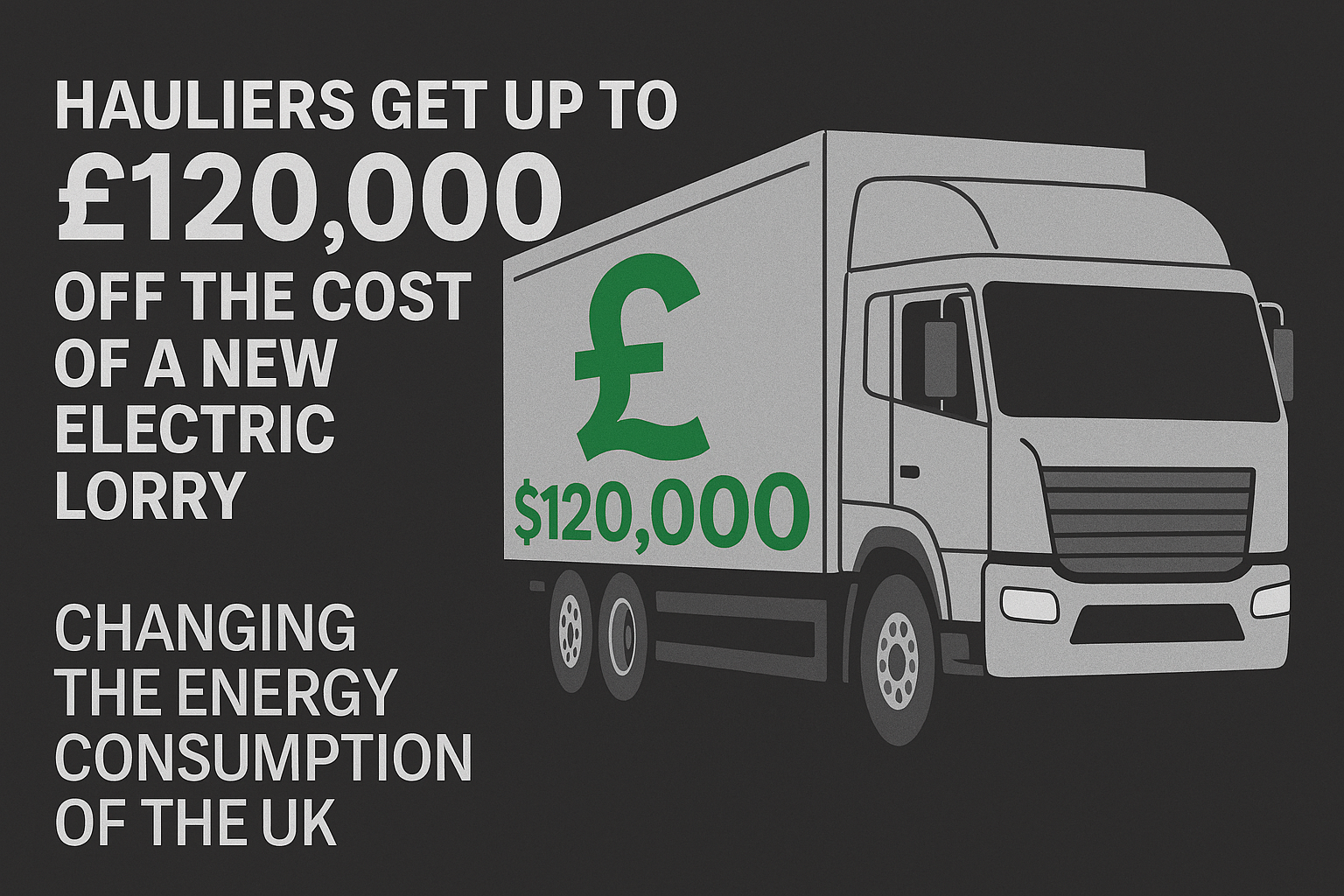
The government has increased support for electric HGVs, offering hauliers up to £120,000 off the cost of a new electric lorry. While framed as a transport announcement, it forms part of a much wider shift in how the UK consumes energy, away from oil based transport and towards an electricity system increasingly powered by renewables.
This wider context matters, especially given recent online claims misrepresenting the UK's energy mix. Electricity generation is already majority low carbon. The real outlier is transport, which remains overwhelmingly dependent on oil. Electrifying heavy goods vehicles is one of the most direct ways to change that.
🚛 Grant Uplift Overview
- Up to £120,000 discount on new electric HGVs until March 2026
- Weight based tiers from £20,000 (4.25-12t) to £120,000 (26t+)
- 2040 phase out consultation for new non zero emission HGV sales
- Industry certainty for long term fleet planning and investment
- Energy transition moving transport from oil to renewable electricity
🌍 Why This Matters: The Energy Transition Context
Heavy road transport is one of the last major sectors still locked into fossil fuels. HGVs alone consume a disproportionate share of the UK's diesel, representing a significant portion of the country's oil dependency that persists despite the electricity grid's transition to renewables.
The Strategic Energy Shift
Electrifying heavy transport delivers multiple strategic benefits that extend far beyond reducing tailpipe emissions:
⚡ Energy System Benefits
- Reduces national oil demand: Direct reduction in diesel imports and dependency
- Shifts energy consumption into the electricity grid: Leverages increasingly clean power generation
- Increases renewables share in total energy use: Expands clean energy beyond just electricity
- Strengthens energy security: Reduces reliance on imported fossil fuels
- Improves energy efficiency: Electric motors far more efficient than diesel engines
Correcting Energy Mix Misconceptions
This policy directly addresses a common misconception about UK energy consumption. While electricity generation has rapidly decarbonised with renewables now providing 42% of electricity transport remains stubbornly fossil fuel dependent:
- Electricity generation: Majority low carbon with rapid renewable growth
- Transport sector: Still overwhelmingly oil dependent across cars, vans, and HGVs
- Industrial heating: Transitioning to electricity and hydrogen
- Domestic heating: Gradual shift from gas to heat pumps
The Plug-in Truck Grant directly tackles the largest remaining fossil fuel dependency in the UK economy, making it a critical component of overall energy transition strategy.
💷 New Grant Structure: Closing the Economic Gap
The updated grant structure recognises that different weight classes face different economic barriers to electrification, with larger vehicles requiring more substantial support to overcome higher upfront costs.
Maximum Discounts Available Until March 2026
| Vehicle Weight Class | Maximum Grant | Typical Use Cases |
|---|---|---|
| 4.25t–12t | £20,000 | Small delivery trucks, local distribution |
| 12t–18t | £60,000 | Medium rigid trucks, regional delivery |
| 18t–26t | £80,000 | Large rigid trucks, construction vehicles |
| 26t+ | £120,000 | Articulated lorries, long haul freight |
The Economics of Electrification
The goal is to bridge the gap between lower running costs and higher upfront prices. Electric HGVs typically offer:
- Lower fuel costs: Electricity significantly cheaper per mile than diesel
- Reduced maintenance: Fewer moving parts, less wear and tear
- Operational savings: No London ULEZ charges, potential road toll exemptions
- Higher initial investment: Battery costs still premium compared to diesel engines
The enhanced grant levels are designed to accelerate the payback period and make electric HGVs viable for a broader range of operators, not just large fleets with strong balance sheets.
🗣️ Government Position: Affordability and Certainty
To underline the policy's intent, Keir Mather, Minister for Aviation, Maritime and Decarbonisation, emphasised both immediate affordability and long term market certainty:
"We're backing British businesses to go green by making electric lorries more affordable, helping hauliers to make the switch whilst turbocharging growth, investment and jobs in the sector.
Our proposals will provide the certainty the industry has been calling for so that Britain becomes the best place for green investment."
This statement reinforces two central themes of the policy package:
🎯 Policy Objectives
- Cost reduction: Lowering immediate barriers for hauliers considering electrification
- Regulatory stability: Signalling a clear, predictable path to 2040 phase out
- Investment attraction: Creating favorable conditions for green technology investment
- Industrial growth: Supporting job creation in electric vehicle manufacturing and servicing
- Competitive positioning: Establishing the UK as a leader in freight electrification
🏭 Industry Context: Building on ZEHID Success
The grant uplift builds on the Zero Emission HGV and Infrastructure Demonstrator (ZEHID) programme, which has provided real world evidence of electric HGV viability across different applications and operating patterns.
ZEHID Programme Achievements
The demonstrator programme has delivered tangible progress in proving electric HGV technology:
📈 ZEHID Programme Results
- £120 million invested in trials and infrastructure development
- Nearly 300 electric HGVs expected on UK roads by March 2026
- Major operators participating including Amazon and Marks & Spencer
- Amazon commitment: UK to host largest number of electric HGVs in their global fleet
- Operational data: Real world performance validation across different duty cycles
Early Adopter Benefits
Early deployment through ZEHID helps de-risk the technology and creates essential market conditions for broader adoption:
- Technology validation: Proving electric HGVs work in UK operating conditions
- Infrastructure learning: Identifying optimal charging solutions and grid requirements
- Workforce development: Training technicians and drivers on electric vehicle operations
- Supply chain maturation: Encouraging UK based manufacturing and support services
- Second hand market creation: Building future used vehicle availability for smaller operators
The participation of major logistics companies like Amazon and Marks & Spencer provides crucial credibility and operational learning that benefits the entire industry.
💼 What This Means for Hauliers: Changing Economics
The uplifted grant fundamentally changes the economic calculation for freight operators considering electric vehicles, making the transition viable for a much broader range of businesses.
Financial Impact Assessment
The enhanced grants address multiple economic barriers:
💰 Economic Benefits for Operators
- Lower upfront costs: Grants make trials and early adoption financially viable
- Faster payback periods: Combined with lower running costs, improving return on investment
- Reduced financial risk: Government support de-risks technology adoption
- Access to premium markets: Zero emission capability opens new contract opportunities
- Future proofing: Early adoption positions businesses for 2040 transition
Operational Considerations
Beyond financial benefits, electric HGVs offer operational advantages that become more accessible with grant support:
- Urban access: Compliance with current and future low emission zones
- Noise reduction: Enabling night time deliveries in noise sensitive areas
- Brand benefits: Meeting customer sustainability requirements
- Driver attraction: Modern, clean technology appealing to workforce
- Maintenance predictability: Simpler electric drivetrains with fewer service requirements
Remaining Challenges
The biggest barriers to widespread adoption remain infrastructure related:
- Depot charging infrastructure: Power upgrades and installation costs
- En-route charging: Limited high power charging for long haul operations
- Grid connections: Lengthy wait times for new electrical connections
- Range limitations: Current technology best suited for predictable, shorter routes
- Vehicle availability: Limited model range compared to diesel options
🔌 Infrastructure Development: The Critical Enabler
While the grant uplift addresses vehicle costs, charging infrastructure remains the critical enabler for mass HGV electrification. The government recognises this challenge and is taking parallel action.
Infrastructure Requirements by Use Case
Different HGV operations require different charging solutions:
| Operation Type | Charging Solution | Power Requirements |
|---|---|---|
| Local delivery | Overnight depot charging | 50-100kW per vehicle |
| Regional distribution | Depot + destination charging | 100-200kW fast charging |
| Long haul freight | Megawatt charging corridors | 1MW+ ultra rapid charging |
Grid Infrastructure Implications
Large scale HGV electrification requires significant grid reinforcement:
- Distribution network upgrades: Higher capacity connections to freight depots
- Strategic charging hubs: Megawatt scale charging facilities on major routes
- Load balancing: Smart charging to manage grid demand
- Renewable integration: Pairing charging with solar and wind generation
- Energy storage: Batteries to smooth peak charging demand
🔑 The Bigger Energy Picture: Transport's Last Stand
This announcement represents part of a fundamental structural transition in how the UK consumes energy, moving away from a fossil fuel dependent economy toward one increasingly powered by clean electricity.
Sectoral Energy Transition Status
The UK's energy transition is progressing at different rates across sectors:
⚡ Energy Transition Progress
- Electricity generation: 42% renewable, rapidly decarbonising
- Industrial processes: Gradual shift to electric heating and hydrogen
- Domestic heating: Slow transition from gas boilers to heat pumps
- Transport sector: Still overwhelmingly oil dependent across all modes
- HGV freight: Almost entirely diesel powered, representing largest opportunity
Strategic Energy Security Benefits
Freight electrification delivers multiple strategic advantages:
- Import reduction: Less dependence on oil imports from unstable regions
- Price stability: Electricity prices less volatile than oil markets
- Domestic generation: Renewable electricity increasingly produced in the UK
- Energy efficiency: Electric motors 3-4 times more efficient than diesel engines
- System integration: HGV batteries could provide grid storage services
Long term Vision: 2040 and Beyond
The policy roadmap envisions a fundamental transformation of UK freight transport by 2040:
- Fully zero emission HGV market: All new heavy vehicles electric or hydrogen
- Renewable powered freight: Transport energy sourced from wind and solar
- Integrated energy system: Freight charging coordinated with grid renewables
- UK manufacturing hub: Domestic production of electric commercial vehicles
- Export opportunity: British expertise in freight electrification technology
📊 International Context: UK's Competitive Position
The enhanced grant support positions the UK competitively in the global race to electrify freight transport, alongside similar initiatives in Europe, China, and North America.
Comparative Grant Levels
The UK's grant levels compare favorably with international support schemes:
- EU: Various national schemes, typically €100,000-200,000 for heavy HGVs
- Germany: Up to €200,000 for electric trucks, strong infrastructure support
- California: Hybrid approach combining purchase incentives and scrappage schemes
- China: Massive subsidies driving rapid electric truck adoption
- UK advantage: Competitive grant levels combined with regulatory certainty
Technology Leadership Opportunities
Early market development creates opportunities for UK technology leadership:
- Battery technology: UK research strengths in advanced cell chemistry
- Charging solutions: High power charging system development
- Grid integration: Vehicle to grid and smart charging technologies
- System optimization: Fleet management and route planning software
- Service networks: Maintenance and support infrastructure
🎯 Policy Assessment: Strengths and Limitations
The Plug-in Truck Grant uplift represents well targeted policy intervention that addresses genuine market barriers while supporting broader energy transition objectives.
Policy Strengths
✅ Effective Policy Design
- Proportionate support: Higher grants for heavier vehicles reflecting greater cost barriers
- Time limited urgency: March 2026 deadline encourages prompt action
- Long term certainty: 2040 phase out provides planning framework
- Technology neutrality: Supports various electric solutions without picking winners
- Industry consultation: 2040 timeline developed through stakeholder engagement
Potential Limitations
Several challenges remain beyond the scope of vehicle grants:
- Infrastructure bottleneck: Charging network development may lag vehicle deployment
- Grid capacity constraints: Power system upgrades needed for mass adoption
- SME access: Smaller operators may still struggle with upfront costs and complexity
- Technology limitations: Current electric HGVs limited in range and payload
- Skills shortage: Insufficient trained technicians for electric vehicle maintenance
📌 Conclusion: Accelerating the Energy Transition
The Plug-in Truck Grant uplift represents far more than a transport policy adjustment. It's a strategic intervention in the UK's energy transition, targeting one of the last major sectors still dependent on fossil fuels and accelerating the shift toward a renewable powered economy.
By offering up to £120,000 off electric HGVs, the government addresses the genuine economic barriers that have prevented freight operators from embracing electric technology. The weight based grant structure recognizes that different vehicle categories face different cost challenges, while the March 2026 timeline creates appropriate urgency for action.
Perhaps most importantly, the policy provides the long term certainty that industry has demanded. The 2040 consultation on phasing out new fossil fuel HGV sales gives freight operators the planning framework needed to make rational investment decisions about fleet replacement, infrastructure, and workforce development.
🎯 Strategic Impact Assessment
- Enhanced grants make electric HGVs economically viable for broad range of operators
- 2040 phase out provides essential long term planning certainty for industry investment
- Policy directly tackles transport sector's oil dependency, last major fossil fuel holdout
- Success depends on parallel infrastructure development and grid capacity expansion
- UK positioned competitively in global freight electrification race
The broader energy context makes this policy particularly significant. While electricity generation has rapidly decarbonized with renewables providing 42% of power, transport remains stubbornly oil dependent. HGVs represent one of the largest opportunities to shift energy consumption from imported fossil fuels to increasingly clean domestic electricity.
Challenges remain substantial. Charging infrastructure development must accelerate to support mass HGV adoption. Grid capacity needs major expansion to handle megawatt scale freight charging. Smaller operators require additional support beyond vehicle grants to navigate the transition complexity.
But the policy framework is now clear: enhanced financial support for early adoption, combined with regulatory certainty about long term phase out. This dual approach balances market incentives with planning security, creating conditions for the freight sector to lead the final phase of the UK's transport electrification.
Success will transform not just how goods move around the UK, but how the country consumes energy. A freight sector powered by renewable electricity rather than imported diesel represents a fundamental shift toward energy independence, economic resilience, and environmental sustainability.
The Plug-in Truck Grant uplift is a tactical intervention with strategic implications, accelerating the UK's journey toward a post fossil fuel economy.